Why Another Kind of AI
General-purpose assistants are good at language. Scientific work needs more than that: precise problem statements, the right computational method, results that can be reproduced, and a record of how each answer was produced.
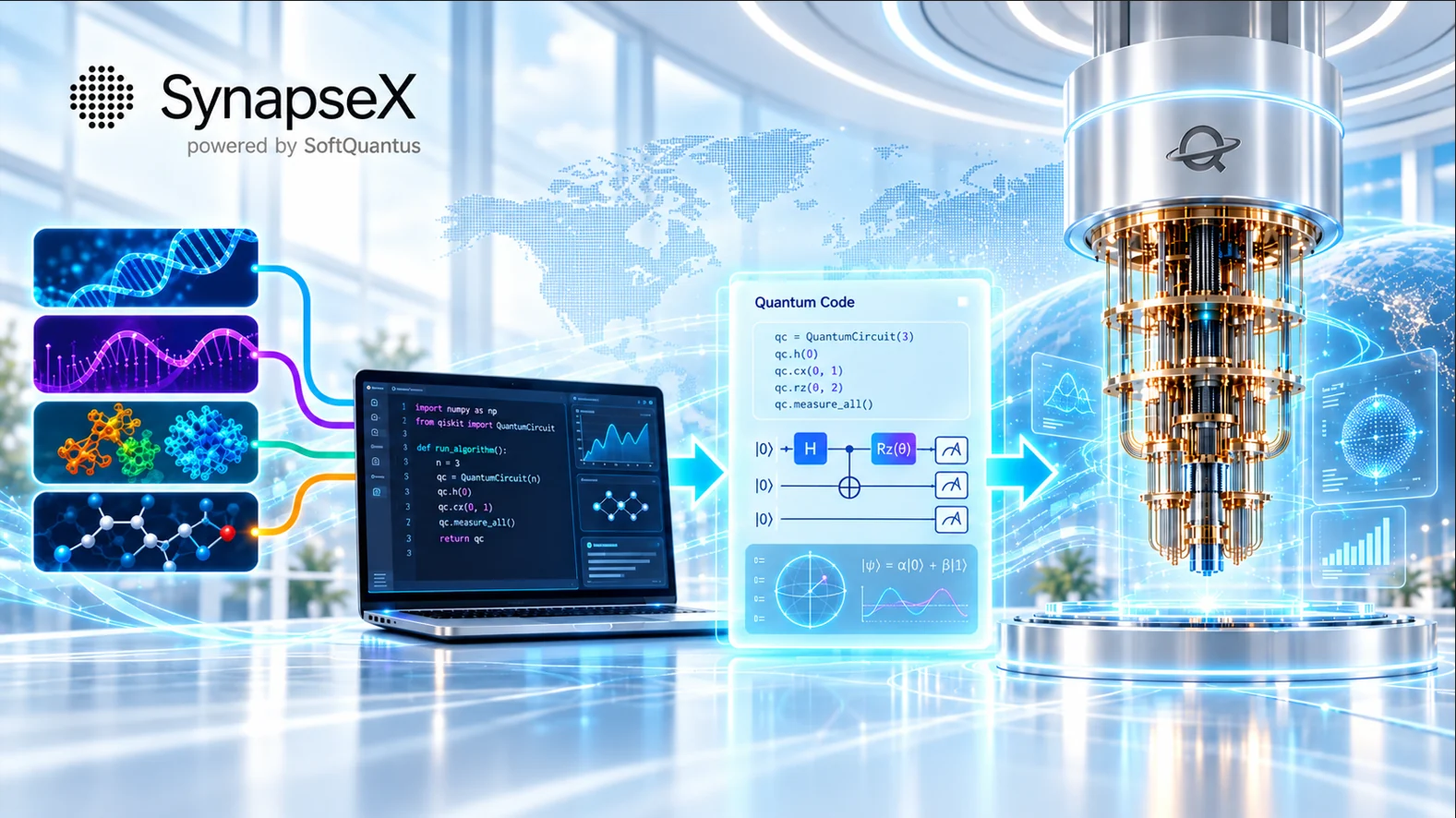
SynapseX is built for that work. It brings scientific reasoning, data and computation into one workspace, and it connects to QCOS, the SoftQuantus Quantum Computing Operating System, for execution.
The SynapseX-Q1 Research Family
SynapseX-Q1 is our family of research models, specialised for scientific reasoning and for working with computational tools. The models are in early access, and we are training and evaluating them on European supercomputing infrastructure.
Our long-term goal is autonomous experimentation: systems that can propose, run and check experiments with a scientist supervising. That is a goal, not a feature you can use today.
One Workflow, Five Steps
Choosing the Right Machine
Not every problem belongs on a quantum computer. Before execution, QCOS runs a computational suitability analysis that looks at the structure and size of the problem and recommends where it should run.
QCOS is hardware-agnostic, so the same workflow can target different machines without being rewritten. QCOS Autopilot, its scheduling engine, makes that choice for each workload.
Results You Can Verify
Each execution produces a record of its inputs, configuration and outputs, sealed with SHA-256 Merkle integrity. Anyone with the record can confirm that it has not been changed since it was produced.
For research teams, that means a result can be cited, reviewed and reproduced. For regulated industries, it means the path from question to answer can be audited.
What Runs Today
Available
- ✓ CPU-based simulation in QCOS
- ✓ Exact state-vector simulation up to 24 qubits through the published API
- ✓ Sealed execution records
- ✓ SynapseX-Q1 models in early access
Under development
- → Partner quantum processor execution
- → Managed GPU execution
- → HPC execution
Where We Are Heading
Pharmaceutical research
Literature and database research, molecular modelling and experiment planning with traceable sources.
Materials & semiconductors
Simulation workflows where problem representation and resource choice decide cost and quality.
Aerospace & energy
Optimisation and engineering problems that mix classical and specialised computation.
Quantum research
Hardware-aware compilation, error mitigation studies and reproducible experiments.
These are development directions, not claims of proven acceleration across these industries.
Vendor-Neutral by Design
SoftQuantus builds its own models and orchestration software, and does not tie customers to a single hardware vendor or cloud. As new machines become useful, they can be added under QCOS without changing how scientists work in SynapseX.
SynapseX is the interface to scientific intelligence. QCOS is the foundation that runs it.
SoftQuantus: Control quantum computers, not quantum noise®