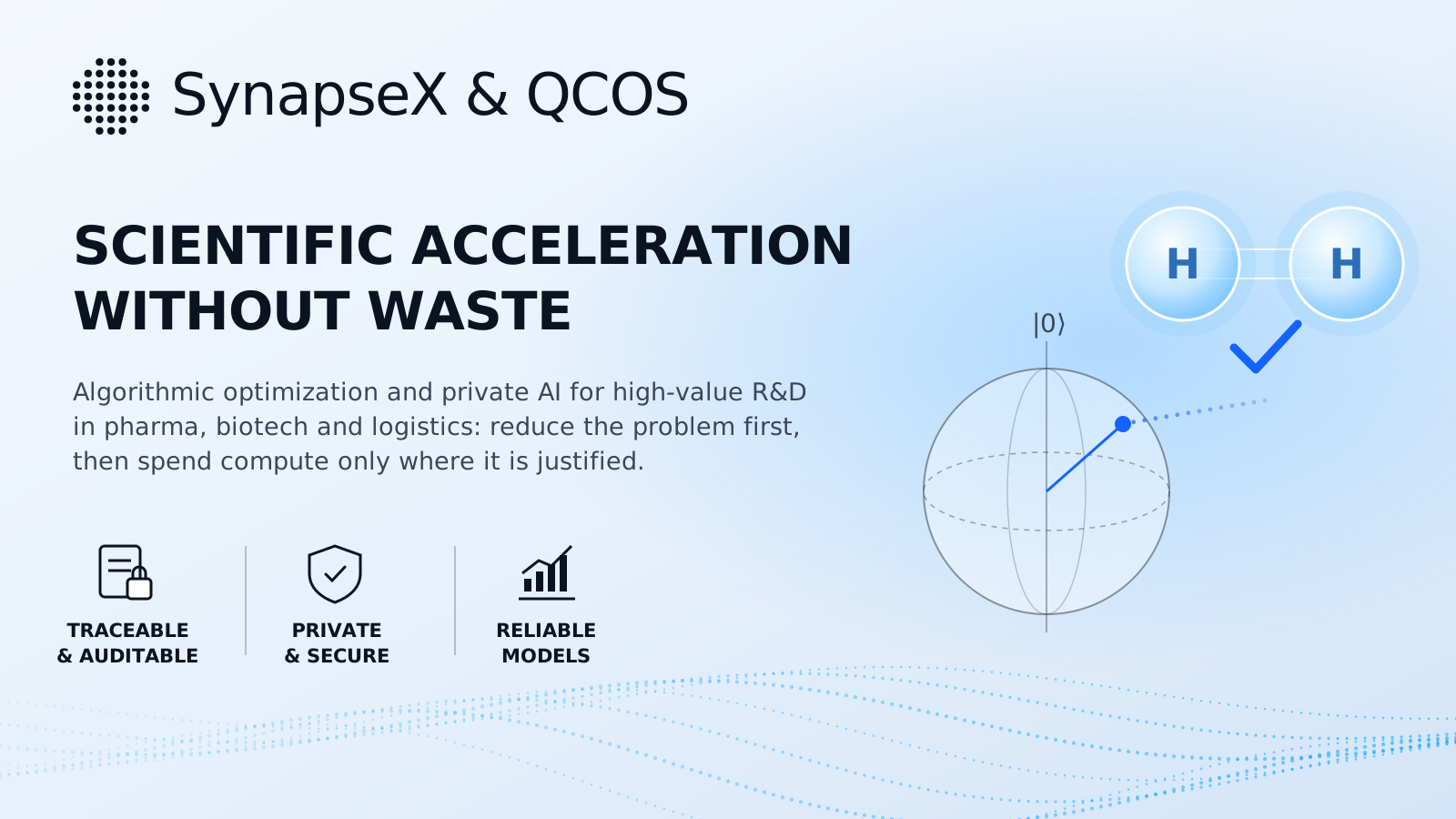
In brief
- Most of the cost in computational R&D is spent on work that should never have reached an expensive machine.
- SynapseX and QCOS reduce the problem exactly first, compete against strong classical baselines, and only then decide where to run.
- Every step leaves a sealed record that your team can verify on its own.
The Expensive Part Is Often Unnecessary
High-value R&D teams in pharma, biotech and logistics have more compute available than ever: cloud GPUs, supercomputers and, increasingly, quantum processors. The temptation is to send hard problems straight to the most powerful machine available.
That is where waste begins. A problem stated loosely is larger than it needs to be. A problem that a classical solver settles in seconds does not need a quantum processor. And a result that nobody can trace back to its inputs cannot support a decision, however fast it arrived.
Scientific acceleration, for us, means removing that waste: fewer wasted runs, less wasted specialised compute, and no results you cannot defend.
Five Steps Before Anything Expensive Runs
SynapseX is where your scientists work. QCOS is the operating layer that decides how and where the work runs. Together they follow the same disciplined path every time.
- 1Frame
Write the problem down precisely
SynapseX helps your scientists turn a question into a typed problem: variables, objective, constraints and the data it depends on. Ambiguity is resolved before anything is computed.
- 2Reduce
Shrink it without changing the answer
QCOS applies exact reductions that remove variables and structure the problem does not need. A smaller problem that is provably equivalent is cheaper on every machine.
- 3Compete
Let classical solvers try first
Mature solvers such as mixed-integer programming, constraint programming and well-tuned heuristics run against the reduced problem. Often they settle it.
- 4Gate
Spend specialised compute only when justified
A candidate moves to GPU, HPC or quantum resources only if it passes explicit gates: the classical baselines did not already solve it, and the expected result justifies the cost.
- 5Seal
Keep evidence you can check
Inputs, decisions and results are recorded with SHA-256 integrity, so a reviewer can confirm later what ran, on what, and why.
An Example: The Best Quantum Run Was the One We Did Not Make
In one internal study we took a frozen set of optimisation problems and ran them through this path before booking any quantum hardware.
- 1.Exact reductions shrank problems with up to 64 variables to small frontiers, and the reduced answers agreed with an established mixed-integer solver.
- 2.Dense cases were solved directly by classical solvers: mixed-integer programming, constraint programming and a tabu heuristic.
- 3.No candidate passed the gates for quantum execution, so no quantum processor time was spent.
In a separate controlled case, an exact elimination reduced a circuit from hundreds of entangling gates to a handful, with the same answer.
That is the outcome we want to be honest about. Sometimes acceleration means discovering that the expensive step is not needed, and having the record to prove it.
Three Commitments
Traceable & Auditable
Each run produces an execution record with SHA-256 Merkle integrity. Answers link back to the input, the method and the source records they came from.
Private & Secure
Your data stays in your own workspace in SynapseX Labs. Evidence can be verified offline by your team, and access is controlled with licences and scoped API keys from the Softquantus Research Platform.
Reliable Models
Results are reported with the method that produced them and the baselines they were compared with. When a classical method wins, the record says so.
Where This Applies
Pharma & Biotech
- •Target and literature research grounded in public biological databases, with every claim linked to its record
- •Molecular modelling workflows that start on classical simulation and escalate only when the chemistry needs it
- •Experiment and screening plans framed as constrained optimisation, solved and checked before lab time is booked
Logistics & Operations
- •Routing, scheduling and allocation problems reduced exactly before they are solved
- •Head-to-head comparison against established solvers, so you see which method actually wins on your data
- •Sealed decision records that operations and audit teams can review later
These are directions we are developing with early users, not claims of proven acceleration across these industries.
What Is Available Today
Available now
- ✓ SynapseX workspaces and scientific tools at chat.synapsex.ai
- ✓ QCOS CPU simulation, with exact state-vector simulation up to 24 qubits through the published API
- ✓ Sealed execution records with offline verification
Under development
- → Managed GPU and HPC execution
- → Partner quantum processor access
- → Broader automated reduction and gating