The Missing Layer
Progress in computing has always come from two things moving together: more capable hardware and software that makes that hardware usable. GPUs were designed to draw pixels. They became the engine of modern AI because a software layer let developers use their parallelism without writing graphics code.
Quantum computing has the same gap, only wider. To run a workload today, a researcher has to map the scientific problem into a quantum form, choose an algorithm, build and optimize a circuit for one device's topology, and then interpret noisy, probabilistic results. Each of those steps needs a specialist.
Better qubits alone will not close that gap. We also need a better way to tell the machine what we want. That is the idea behind Tesseract.
Tesseract: Start From the Problem
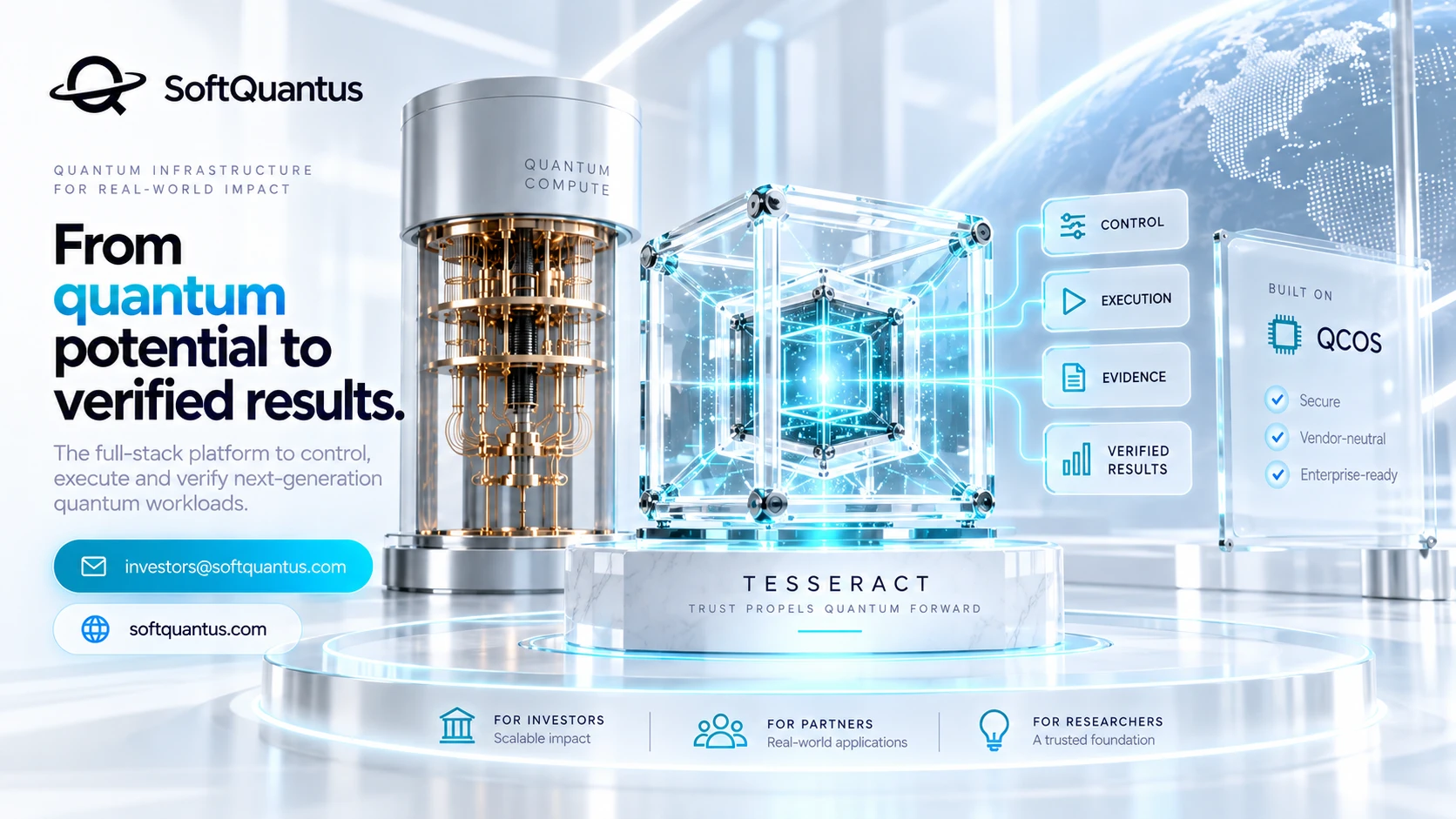
Tesseract is the mathematical intelligence and problem-translation engine that SoftQuantus is developing as part of the QCOS vision. A chemist, an engineer or a mathematician describes an objective, a physical model or a set of constraints. Tesseract converts that description into a rigorous, typed representation that keeps its mathematical structure intact.
QCOS, the SoftQuantus Quantum Computing Operating System, takes that representation and handles compilation, orchestration, execution and verification.
From Intent to Verified Results
- 1ProblemAn objective, a physical model or a set of constraints, written the way a scientist thinks about it.
- 2TesseractTranslates the problem into a typed mathematical representation and checks that nothing was lost.
- 3QCOSCompiles, schedules and runs that representation on the resource that fits it.
- 4HardwareCPU, GPU, HPC or a quantum processor, each with its own native operations and noise.
- 5Verified resultThe answer is checked against the original problem, not only against the circuit that produced it.
The chain looks simple. What it does is hard: it separates scientific intent from hardware implementation.
What to Compute, and How
Quantum hardware is not converging on one design. Superconducting circuits, trapped ions, neutral atoms and photonic systems each have different native operations, connectivity and error behaviour. A program tuned for one often has to be redesigned for another.
Tesseract
Decides what to compute
Structures the mathematical intent and validates that the representation still means the original problem.
QCOS
Decides how to compute it
Compiles, schedules and verifies the work for the target architecture, and records what ran.
Problem-native does not mean quantum-only. Many tasks are best solved on CPUs and GPUs, and others fit hybrid HPC and quantum workflows. The goal is to send each mathematical structure to the resource that suits it, and to say so when a classical method is the better choice.
What Real Hardware Taught Us
We have moved from architecture design to physical validation, comparing runs on real quantum processors against controlled classical and simulated references.
Elegant on paper is not robust on hardware
Algorithms that look efficient in theory can degrade quickly once real devices add noise, limited connectivity and routing overhead.
Representation decides quality
Compact formulations that are mathematically equivalent to the original problem behaved much better on today’s processors than larger, naive encodings.
Most of the work happens before the first gate
In one controlled case, an exact reduction shrank a circuit from hundreds of entangling gates to a handful, without changing the answer.
The quality of a quantum computation is largely set before the processor runs its first gate.
Hardware and the European Ecosystem
- •IBM Quantum. End-to-end workloads executed on IBM superconducting processors, with results checked independently against the original problem.
- •Lucy, France. A 12-qubit photonic quantum computer built by Quandela and hosted at CEA's TGCC within the EuroHPC network. A target platform for photonic workflows and hybrid HPC and quantum integration.
- •Euro-Q-Exa, Germany. A 54-qubit superconducting system from IQM hosted at the Leibniz Supercomputing Centre. A target testbed for scaling workloads and measuring compilation efficiency.
The European systems are part of our evaluation plan. Results on them will be published once the runs have been completed and verified.
Where We Are, and What Comes Next
Demonstrated
- ✓Typed problem representations with automated mathematical validation
- ✓Hardware-aware compilation strategies for different execution models
- ✓End-to-end execution on IBM Quantum superconducting hardware, checked independently against the original problem constraints
- ✓Measured effect of circuit compaction on physical execution quality
Next
- →Broader classes of mathematical problems
- →Reproducibility across hardware platforms, including photonic and larger superconducting systems
- →Rigorous benchmarks against the best classical solvers and heuristics
- →Full integration of Tesseract into QCOS as a general translation engine
A Note on Scientific Rigor
These are engineering milestones, not a claim of quantum advantage. Tesseract is active research and development, and its full integration with QCOS is still in progress. We have not shown that it works on every kind of hardware, and we have not shown that it beats the best classical solvers.
The Future We Are Building
Picture a materials scientist modelling molecular interactions, or an engineer optimizing a complex system, who describes the problem and gets back a verified answer, without ever choosing a gate set or a qubit layout.
That is the computing model Tesseract and QCOS are being built for: the scientist owns the question, the system chooses the right machine, and every answer can be checked.
References
- 1.R. Piccoli (2026). Beyond Quantum Circuits: Introducing Tesseract, SoftQuantus' Vision for Problem-Native Quantum Computing. LinkedIn. linkedin.com/pulse/beyond-quantum-circuits-introducing-tesseract-vision